Showing posts with label the write stuff. Show all posts

Friday, April 2, 2021

My Love/Hate Relationship With NaNoWriMo


I love everything about Nanowrimo. I love the community, the authortube videos, the motivation boost it inspires in aspiring writers. What I don't like is the fact that I always sign up for nano and never win because I fall behind, get discouraged, and inevitably give up. I know someone out there is going to say that the problem is with me, not nanowrimo itself, and that's fair. However, now every November I've learned to just stay away from the new projects page and just enjoy the social media content that goes with it. Sadly, while nanowrimo can be a great motivator for some, it's become a toxic affirmation of me failures and I really don’t need to keep putting myself through that.


Thankfully, nanowrimo has a way more approachable sibling, camp nanowrimo, which lets you set your own writing related goal. You can set your own writing, editing, or drafting goal instead of the set 50,000 words in 30 days. This makes it easier to set more realistic and attainable goals (at least for me).


This camp I'm committing to writing every single day for at least 30 minutes. It may not seem like a lot to some but I'm a burst writer (I write a lot in the span of a few days, burn out, and don't write for weeks) and  my goal is to build up a habit of consistent writing.


Remember camp nanowrimo is not a competition. It's about helping YOU achieve YOUR goals. ANY PROGRESS IS STILL PROGRESS, no matter how small. I'm hoping this camp will help me built up confidence and consistency - the kind of writer that can sit down and commit to write every day - no matter who many words I may write.


_*_


Are you participating in camp nanowrimo? What's your writing goal? Let me know and have a lovely Friday!


Wednesday, March 31, 2021

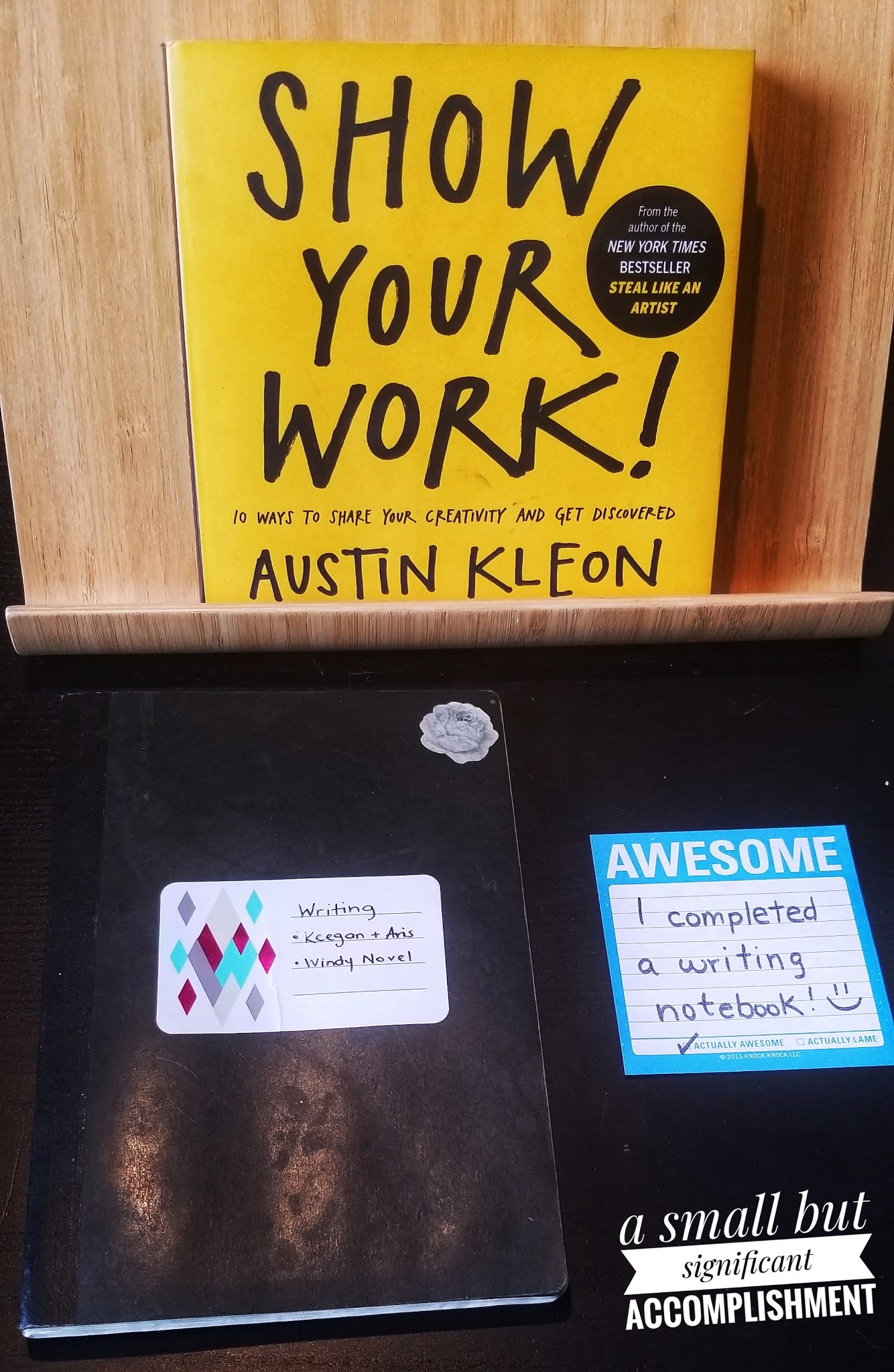
A Small But Significant Accomplishment!

 I finished a writing notebook! I had to share this small but significant accomplishment with someone! I have so many notebooks (TOO many) and I've always had a hard time filling them up because I didn't want to ruin them with my crummy writing. Completing a notebook undoes that kind of negative thinking so much. Not only am I using up something I love that I've been hoarding, but I've also kept writing despite the negative critic in me. It's taken me a while to finish this notebook (a little less than a year because I switch between handwriting and typing my work) but it's an accomplishment, small but significant, and I hope to fill up many more in the future. 


I'm currently doing a reread of Show Your Work by Austin Kleon and it's prompted me to make this post. This book may be small but it's a treasure and is teaching me that small steps to a bigger goal are indeed important and significant and that showing your work and sharing with others makes a solitary activity, like writing, seem less lonely. I will probably do a recommendation after I'm through with this reread but I really cannot recommend this book enough! 


Do you write? If so, what are you working on? Wishing you all the best! 


Wednesday, October 10, 2018

5 Bad Creative Writing Tips That Can Sink Your Project

I've recently been making a real effort to finish a novel by the end of this year (though at this point, and with how much I draw out my scene, that seems a bit over ambitious). I've switching my methods of accomplishing this task a few times (making a word count goal for each day, trying a writing challenge, making a specific time commitment that needs to be completed by the end of the day) but I've found that some of the things that had been making me doubt myself or have set me up for several days of writer's block was well-meant advice that just doesn't work. I'm not saying that the methods I'm about to mention NEVER work, just that they didn't work FOR ME. So here are five writing tips (either told to me or found on the interwebs) that have completely thrown my off my writing game.


  1. You're either a Plotter or a Pantser

    I know this isn't advice per say but bare with me. I generally hate labels since they're really restrictive but as a writer, hearing this idea "you're either a plotter or a pantser" has made me feel like if I wasn't subscribing to one over the other, I wasn't doing it right. But first, what's the difference between a plotter and a pantser?

    A plotter is someone who plans the bulk of their writing before even beginning their first draft. They have a list of scenes for their general plot outline, character descriptions, and a lot of world building or theme related information already figured out before they put pen to paper or start typing their first few words.

    A pantser, on the other hand, is someone who "writes by the seats of their pants". This means no planning whatsoever. You write where ever the narrative takes you.

    One method isn't any better than the other and picking a method is completely up to personal preference. But a lot of people are really serious about where they fall on this spectrum of planning or not planning and I feel this can be really damaging to new writers. Newbie writers may feel like not falling into either one of these camps may mean they're "doing it wrong" when that's just not the case. I personally use a combination of the two. I don't plan the entire story arch and in fact, only go as far as to write bullet points of whatever scene I'm working on at the moment to help me see where the scene could go. If the scene goes in a different direction than I'd planned, I'm not overly bothered because the rest my story line hasn't been completely derailed by these changes. I keep ideas for the future scenes in a notebook and have a system for how to incorporate them into the larger unplanned story arch. I think this system gives writers a lot more freedom in their writing and if either of them don't work well for you, create your own hybrid system.

  2. You have to write scenes chronologically.

    I used to think this one too. How can I write scenes out of order? The thing is, sometimes you get stuck in your writing. Maybe a scene isn't working out the way you wanted it to or you don't know what comes directly after the scene you're working on now. This can be a huge road block. Scenarios like this have held up my writing for days but if you just outline a later scene or even start drafting it, you're still writing, you're still furthering your story line and it might just help your creative juices get flowing enough to help you figure out what scenes you'd need to get from your last scene to the one you're working on how.

    I think this is especially important for starting a writing project. If you're having a hard time writing the beginning of your story, start somewhere else. I was having a very difficult time starting my story but had the inciting incident so solidly and with such detail that the scene played out like a movie in my mind. So instead of being frustrated with the beginning of the story and feeling like I had to edit and edit and scrap and edit some more before I had anything I could work with, I decided to leave the beginning for later and start writing the inciting incident. And honestly, that method has been working really well. Because I had a clearer picture of where I where the scene was going and what might happen afterward, I've been able to keep the narrative going without much problem. I'll go back and add the "beginning" in later during my next draft.

    This method is also really helpful for scenes that get excessively long and that fizzle out while you're writing. I know me. I know how likely I am to abandon a writing project when I'm frustrated that I'm still stuck in a scene (especially one that already has a clear beginning, middle, and end but is taking me forever to get through). Instead, I write down what should come next to finish the scene without actually writing out the full scene (with dialogue, and such) and just move on to the next piece of the story. Again, it can be filled out during editing or when I start my next draft.

  3. I should stop writing/ start over if my first draft feels awful.

    Please don't. It's unrealistic to expect your first draft to be filled with "great writing". This is not to say that your first draft will be garbage, but it won't be a work of art either.  There will be too much exposition, awkward dialogue, and a lot of stuff you're probably going to have to cut later. you just have to go with it. As Christina Dodd says:

    "You can always fix crap. You can't fix a blank page. "

    And she is one hundred percent right. It's better to have content to work with than letting yourself worry about how your draft MIGHT turn out. Putting off writing because of how bad you feel your writing is or deleting everything can be a way to procrastinate with your project. I'm not saying to never delete anything but you might want to make sure that you're not deleting a bulk of what you've accomplished in a day. Instead, make notes on what you'll change later and use that when you're writing your future scenes.

    Even if your project doesn't turn out great the first time around at least there's a next step for you to take in fixing it and just the writing process alone will teach you more about the project and the characters you're creating. It'll might be in the next draft that you'll flesh them out so don't stress about how awful it is, just keep going and trust that you'll be able to fix any problems in your next draft.

  4. You should compare your works with that of other's

    Sigh. I think when people talk about this, it's explain the basic story or theme with something people can relate to when they ask you about your writing project. "Oh, my story is a mix between Harry Potter and Vampire Diaries". However, starting to compare your work with published authors may not be a good idea. Comparing your draft with a published piece of work may discourage you. Keep in mind that your draft is unfinished, hasn't been edited by an editor, and is still in it's beginning stages. Many of published authors have been writing for years and are on a different level in their author/ writing journey than you are. You'll get there too.

    More than that though, don't compare yourself with other writers at all (even those who are on a similar level than you). As someone who watches a lot of Youtube, I follow a few author-tube channels and have found myself comparing myself and my writing to others (especially during things like NaNoWriMo). I watch as these self-published and aspiring writers bad out 1800 words in a half hour. I can't do that. In fact, I write about that much in an hour and a half. And for a while, I felt really discouraged about things like this but when it comes to writing, I've learned its's really just about running your own race. When horses race, they are given blinders so that they don't focus on all the other horses on the track. They just focus on themselves and run their own race to the best of their ability. You have to do the same with your own writing. Focus on your project and your progress. And if anything, use other people's success as motivation for reaching your own success - think "if she can do it, so can I"!

  5. Don't borrow from other works

    Nothing in the world is truly original. People borrow from other works all the time to find inspiration for their own projects. The key to borrowing is to take something you really enjoy and spin it! You like stories about boarding school? What can you tweak to give a fresh take on something that's already been written about? Make sure that when you are borrowing from other people's material, you're doing so in a way that is respectful and isn't plagiarizing. If you're copying directly from a text, that's plagiarism and extremely illegal. But don't let people make you think that you can't write a story about something someone's already written about. The Hunger Games was about dueling to the death to win a competition (obviously there's more to it than that but we're talking bare bones for right now). Now let's think of another book that has a similar bare bones premise - Throne of Glass and Crown's Game are just a few Y.A titles that fit this description.

    The point is they are similar but not the same. The authors could have drawn inspiration from each other but obviously the differences in the works are vast enough that you don't think of them as being the same. Find something that draws your interest, borrow from that work, create your own twists and change the type of characters you - you'll end up with something totally different than what inspired you in the first place.
I hope bringing some of these tips to light may have helped writers from getting discouraged or feeling like they're doing something wrong. Reading or looking up writing advice online or in books isn't necessarily a bad thing but you need to evaluate what does and doesn't work for you. Writing like most things is a process and something that works for one person may not work for you and vice versa.

Good luck to any writers doing Preptober! I wish you guys all the luck in the world in preparing for NaNoWriMo!!


Wednesday, May 11, 2016

A Beginner's Guide To Planning Your Novel


I've been trying to write a book for the past sixteen years. I haven't been too successful. So why should you listen to anything I have to say on how to plan your novel? Well, planning has always been my strong suit, it's the actual writing that's been the problem - getting the words down in a way that sounds right to me so I don't abandon the project.

Some writers (known as pants-ers) don't believe in planning. They go wherever the story takes them and fix mistakes in the editing process. I admire these people and used to try to write in a very similar way but found that I just rambled for much too long on dialogue that went nowhere and scenes that meant nothing. That's when I began reading books on writing books to help me better understand the components of a novel - what was needed in order to form dynamic characters, a plot that had purpose and direction, and themes that readers could relate to. After a few years of research and planning out several novels, I've found a system that works for me. I do not guarantee that it will work for everyone but I hope that you'll find it useful.

In order to plan a story (and keep in mind that most of my stories are character driven), I separate my planning into three parts:

1. CHARACTER

2. PLOT

3. THEME

These are the three big things that I try to focus on while coming up with a good story. Obviously, there are other parts to story telling (setting, tone, etc) that are equally important, but I find that focusing on these three things give me a good foundation to figure out the rest of what makes a story great.

When using this model, I start with character and usually branch out. When focusing on CHARACTER, ask yourself, who is this character? If they were person (your neighbor, someone at your school or work) how would you see them? How would you label them? A lot of authors use this method as a starting point for their characters. In Harry Potter, for example, Hermoine is the smart one and Ron is the funny/loyal one. Obviously the characters are more complex than that but you can see how this is a jumping off point for Rowling to build her characters. When building your characters ask yourself:

i. What is this character's history?

ii. What kind of personality do they have?

iii. What habits do they have?

iv. What do they look like?

I usually answer all of these questions by setting up a bullet point system where I write any and all facts that come to mind about each of my characters. I then write a  few paragraphs about each of my characters (almost like a psychological study). This should read like a wikipedia page of any important information a reader might need to know. This does not need to be extensive and isn't really necessary to building good three dimensional characters but I enjoy doing it and it helps me really understand my characters.

The next thing I focus on when planning a long story is PLOT. Here you're essentially thinking about what specifically is happening in the story and thinking about where you want the story to go. It's important to know the basics of plot, which state that a plot is broken up into three major parts:

1) Introduction - this is the beginning of the story. It shows who your character is and where they are in life. Keep in mind that your character should feel like there is either something missing in their lives that they must gain, an obstacle they must overcome, or they are unassuming and are called upon to do something magnificent. This is because there needs to be some change in the character throughout the book. So this first part is the part where the reader who the character is BEFORE whatever is going to happen, happens.

2) The Middle - This is the biggest chunk of the three. This is where the character is finally called up, realizes what they need to to, etc. This is a huge bulk of the book because this is where you character grows, learns (how to be themselves, how to defeat the enemy, the skills needed to overcome the obstacle, etc). Here the character is learning about their problem and what tasks/ character traits are necessary to fix them. They try and mess up, learning new lessons. And as this section comes to an end, they are almost ready to face whatever the problem in the story is.

3) The End - The end is basically the boss battle at the end of the book. The boss battle can be anything from realizing finally that you've chosen the wrong guy and therefore should break up with the jerk that's been mistreating you (so you can date the nice boy next door who's always been there for you) or it can be a literal battle between a protagonist who is fighting in the name of good against an antagonist who is trying to spread evil across the land. Here the character must wield everything they have learned in order to defeat the big bad.

Now, the way I start with plot may seem a little odd (basically thinking about who my character is and where they are in life) but this is a great place to start when writing a character driven piece or even just helping you piece together where you should start your story at all. So ask yourself these questions:

i. What is my characters life like before the thing that changes everything?

ii. What does my character need to learn by the end of the story?

iii. What does my character want? What motivates them to move forward and change?

iv. You character will come close to achieving the goal but there must be pitfalls. What is your character's setback? What does this mean for the character's growth (and how do they take the loss)? What does this mean to your character's goal?

v. The character comes to a fork in his/her life where they must show all they have learned so far. What does you character need to show they've finally become able to do? What must they give up to achieve this goal?

Finally, it's time for you to think about what THEMES you want to explore in your story. I like to do planning in this order because by the time I get to themes, I already have a lot of content to draw on. Knowing who your characters are and where you plot is (likely going because let's be real, everything is subject to change during the actual writing process), helps to cement what themes you might be exploring and how to bring them out better in your story. When considering themes, look at the (internal and external) challenges your characters are facing and think of how this can be translated into themes which can come in the form of:

--> relationship between parent and child                        --> questioning authority

--> identity                                                                          --> death

--> economic class                                                          

--> gossip/ lies

Once you find these (or other) themes with your story, talk about which characters portray these themes and give an overview of on how each theme shows up in that character's storyline. This may help with some background story for your characters or illuminate some scenes you haven't thought of in detail.

I personally like to do variations on themes in my stories in order to give more depth. For example, one of my stories goes into parent/child relationships. The girl's mother dies in childbirth, she is raised by her uncle, and is forced to move and live with her father when he remarries, giving her a stepmother (a new mother figure). Now there are three different parent child relationships being explored:

1) The relationship between her and her uncle. He is her surrogate father and has raised her for the first 14 years of her life.

2) The relationship between her and her father. Her father was absent for the majority of her life and is distant with her even after she moves in with him.

3) The relationship between her and her stepmother. Her stepmother is very judgmental and nitpicks at how she is though she has the best intentions and has always wanted a child.

This way, the theme is more complex because the reader can see three different version of this relationship and start asking questions like who is the better parent? Is being a parent defined by who births you? Can parents hurt their children even when they have good intentions? Can a parent love a child and be unable to show it? Etc.

After this, you are ready to get deeper into plot planning or to start writing your story. I hope this brief overview had helped you. If your writing process is different please let me know and if you would like more in depth explanations of each section, please let me know.

Happy Writing!


Sunday, August 30, 2015

App Review: Hemingway

Hemingway is an online text editor app started by two brothers Adam and Ben Long who had realized that their writing was hard to understand because of long, imprecise sentences. This text editor is said to help writers have bold and clearer writing and while bold and clearer writing - much like Hemingway's signature style which was direct and precise, with short sentences that said volumes.

You can access Hemingway App on your web browser by going to www.hemingwayapp.com. The app is also available as a desktop app or program is you are willing to pay $9.99. I would personally stick to the website since the website doesn't specify any special features for the desktop version.

Hemingway opens to a page full of writing that explains how the app works. There are color coded highlights to show you possible writing mistakes that Hemingway has found in the writing. These mistakes include: hard to read sentences (how clear what you are saying is), superfluous word choices (see what I did there? :P), adverbs (which may be place-holder words that don't add meaning to your sentences), and when you are using passive voice. The Hemingway App also tells you what grade level your writing is in. Hemingway can also be used as a tool to see if your writing level is suited to your audience.

Keep in mind that most articles in newspapers are written at a 6th - 8th grade reading level.


In order to put your text into Hemingway, just click on the writing explaining the program, delete what's there and either start typing or paste your text in. These tools are great may be helpful in some situations but not all. Here are some instances where using the Hemingway app would make sense:


  1. Blog Writing

    This is when your writing really does need to be precise and to the point - and writing at a 6th grade reading level may be to your benefit. For the most part blog articles are expected to be short and sweet and to the point. Make it too long - and your readers don't make it to the end. Make it too short - and you might as well have just posted that on twitter. In this Hemingway will root out unnecessary words and make your writing clearer.

  2. Creative Writing

    Now, this depends on your writing style. Hemingway was known for being the opposite of flowery so if you like long flowing sentences that sound pretty - this app will just highlight everything you write. After testing some of my own creative writing, I found that this was not really for me. I like my adjectives and adverbs and honestly, as long as you're not overdoing them, what's the harm of keeping them in your story?

  3. Essay Writing (BUT only for grades 6-10)

    Hemingway can be used as an effective editing tool for essay writing if you know how to use it properly. For younger students, Hemingway will point out when your sentences need to be separated into smaller sentences (usually when your sentences are hard to understand) or when you are using too many unnecessary words. For younger students, this tool is extremely useful because you're still learning to communicate your ideas in writing. It will root out common mistakes like passive voice (which really shouldn't be used in essay writing) and overuse of adjectives and adverbs.

    As you start to get older though, you may start to outgrow the Hemingway App. I tried putting in one of my A grade college essays into Hemingway ( I was a British Literature major in college) to see what it would say and well, Hemingway was not happy with me. The overall paper was grade level 13 (which is deemed "okay" in clarity) and I had a lot of long (though grammatically correct) sentences Hemingway was more than happy to highlight. My introduction paragraph as a standalone was grade level 18 and the clarity was considered poor. Suffice it to say, there were a lot of highlights in my intro.


Honestly, I was a bit bummed. I got an A on this paper and I remember being really proud of it. And because of this, Hemingway may not be suited for college grade essay writing.

To learn more about the Long brothers and how the created the Hemingway App, check out this New Yorker article.

If you've been using the Hemingway App please let me know how and if it's been working for you. If you've never heard of it before, check it out and let me know about your experience with the app. I hope this helps some of your with your writing. Good luck with your assignments. 


Friday, July 31, 2015

Hail NaNoWriMo


For everyone who hasn't heard of NaNoWriMo - and seriously, who are people and where have you been hiding?! - NaNoWriMo stands for National Novel Writing Month. This is an event held world wide for anyone who's ever had the goal of writing a novel. Annually taking place in November, NaNoWriMo encourages writers to complete a 50,000 word transcript by the end of the month. This is a great kick in the butt for people like me who spend all year coming up with novel ideas that I never have time to sit down and write. A month means a short 31 day commitment and the website has amazing tools to help you as you write your novel.

The website asks that you create a username and password in order to be part of the event. The whole process is simple and free. Once you've signed up for one year, your account can be used every year during NaNoWriMo. The site suggests that you title your project and provide a blurb. After that, all you have to do for the next 31 days is write. You can log the number of words completed as you write throughout the month and a status page for your project will tell you the average amount of words written per day, the total amount of words already written, what day you're on in the challenge, how many days you have left, and how many words you should write a day in order to meet your 50,000 word goal. If you complete the 50,000 words, you're asked to copy and paste the text into a text box to that the site can verify your word count and no one else will be able to see or steal your writing material. Throughout the month, you are also sent encouraging emails by professional writers giving advice on how not to give up and other writing problems such as: procrastination, writing blocks, structuring stories, etc. Once you've won by completing 50,000 words, you are offered a prize for you hard work (given to you by companies who sponsor NaNoWriMo) that can be seen here.


As someone who never has the time to write during the fall because work as a tutor is A LOT more hectic during the school year, I've opted to do Camp NaNoWriMo which is offered during the summer. I'm enrolled in the July Camp and really like the difference in how the program is run differently. To start, because it is called a camp, you are offered the chance to be placed in a "cabin". This means that you can be put in a group with people who are similar to you in what genre you are writing, age group, word count, etc (although you choose only one of these for your cabin assignment).

Your cabin cannot see the text of your story but are shown the title and word count progress of your work. And best of all, you're around to encourage each other and give advice and commiserate about how tough the writing process is. The camp also allows you to pick your own word count goal as opposed to the fixed 50,000 word goal of NaNoWriMo in November. Other than that, you still have the same stat tools to help you monitor your progress and keep you on track and still receive inspirational emails filled with pep talks and advice.. At the end of Camp NaNoWriMo, you are also offered prizes after validating your work count. These prizes can be seen here.

NaNoWrimo is a great opportunity for those who really want to write a book. It's a great community of people and the site offer write-ins, where you can travel to a give location and write with other people who are signed up for the event.

I really recommend this to people who write or even as a great experience. Completing NaNoWriMo goals fills one with a SERIOUS sense of accomplishment. Please check out the sites and consider signing up yourselves. The July camp is already half way through but you can still sign up and complete 10,000 words (or whatever smaller goal you have in mind) by the end of the month.

Good luck guys and keep calm and write on.